

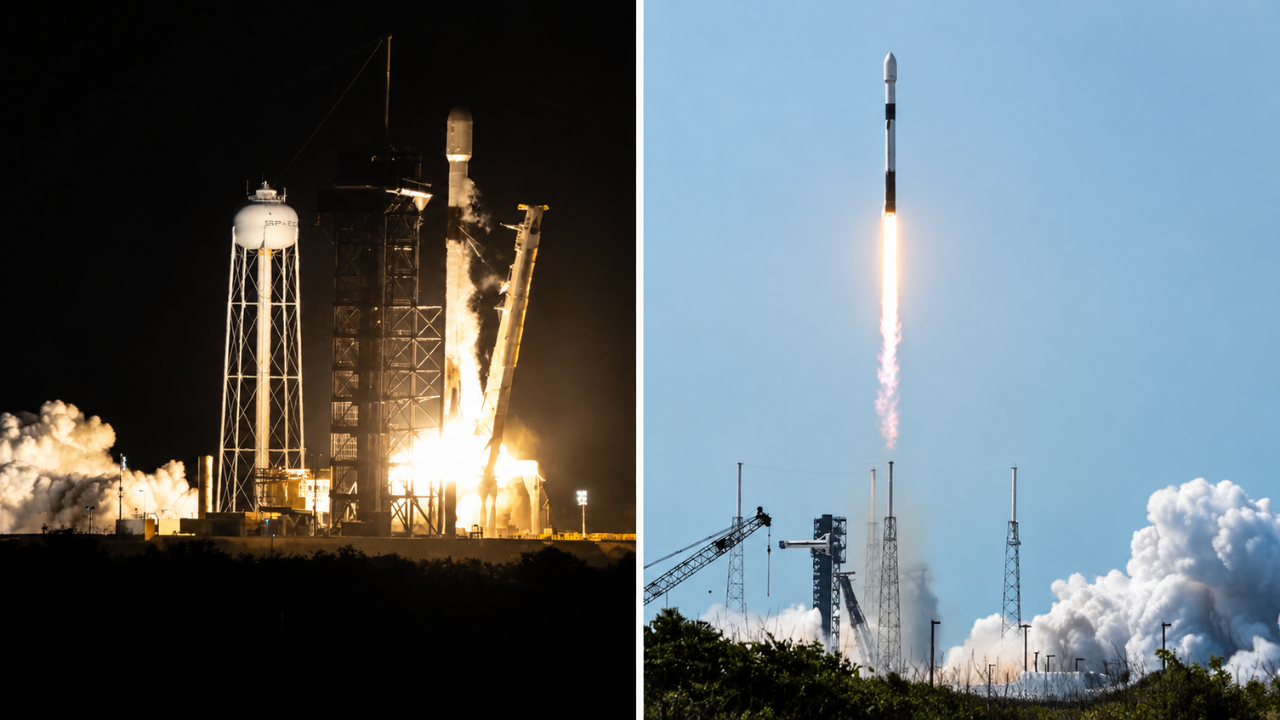
A defunct SpaceX rocket part is heading for a collision with the Moon, when the abandoned vehicle will hit the lunar surface after years in space. The event is of interest to space scientists and astronomers because accidental impacts on the Moon can give useful information about spacecraft performance and planetary environments.
This so-called SpaceX rocket Moon impact is space junk no longer in service and drifting through space with no active control. To confirm the exact time, position and spacecraft involved in an impact, consult official tracking organisations.
Dead Space Hardware Goes Out With a Bang
Debris can orbit or fly around in deep space for years after its original mission.
“It’s harder to track things around the Earth than it is to track satellites in low Earth orbit. Predicting where they will land is hard because of small trajectory changes, gravitational effects and limited tracking data.
Astronomers and tracking teams are analysing the spacecraft’s final trajectory.
Scientific Opportunities of Moon Impacts
That sounds scary, but a spacecraft out of control crashing into the Moon is not a threat to humans.
The Moon is not permanently inhabited, and is often impacted by natural objects such as asteroids and meteoroids. By studying these events, scientists can learn about the Moon’s geology and surface conditions.
An intentional or accidental impact can also give us insights into how materials behave when they strike the lunar surface.
Tracking Space Objects Is Growing in Significance
As more and more companies plan to go beyond Earth on missions, tracking space hardware is becoming a more difficult task.
Artificial objects including commercial rockets, satellites and exploration vehicles are making space increasingly cluttered. These objects can be tracked by researchers to understand possible risks and help plan future missions.
Space agencies forecast the objects’ movement using computer models, telescopes and radar.
SpaceX Has Created Deep-Space Operations
Today, SpaceX is one of the most active private space companies in the world.
Falcon rocket launches, Starlink deployments and NASA collaborations have made the company a major player in modern space exploration. Some rocket stages are intended to return to Earth or be disposed of in a controlled manner, but older hardware may remain in orbit around Earth after their missions are complete.
Space debris management is an issue which is increasingly becoming a concern in the industry.
Environmental Problems Space Debris
Although the effects on the moon are not expected to be harmful to the Earth, scientists are continuing to study the long-term effects of the space debris.
Future lunar missions could lead to even more activity around the Moon and make responsible spacecraft disposal and tracking even more important. Space agencies are developing guidelines to help reduce unnecessary risks and protect scientific sites.
With increasing exploration, protecting key sites on the Moon may become a priority.
Scientists Witness Collision Event
If conditions are right, telescopes and spacecraft instruments could see the impact.
The crater, dust plume and surface changes caused by the impact might offer useful scientific information. Researchers can compare their observations with computer simulations to learn more about lunar collisions.
These studies also can help support future human and robotic missions.”
Sources
- NASA – Moon facts, space tracking, and mission information.
- SpaceX – Official launch and spacecraft updates
- European Space Agency (ESA) – Monitoring and investigation of space debris.
- Space-Track – Satellite & space object tracking data.
- Scientific American – Coverage of astronomy and space research.