

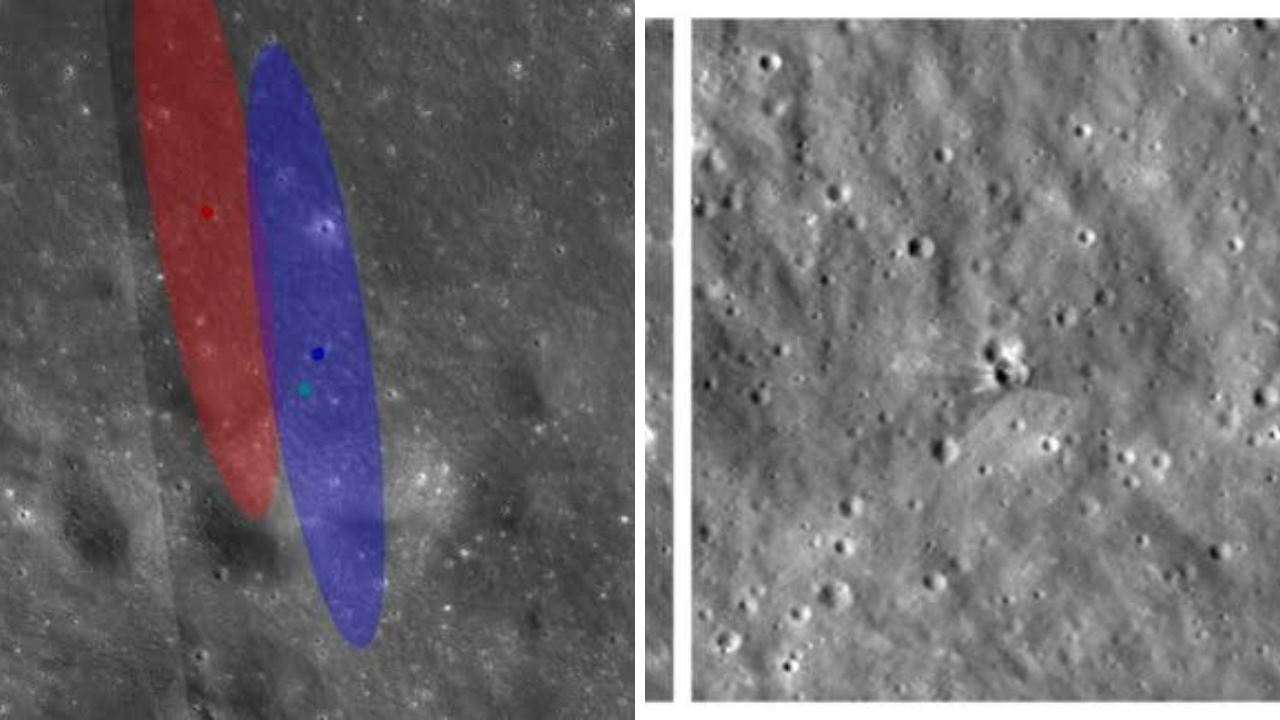
NASA Images Reveal Huge Lunar Crater – NASA images have shown a large crater on the Moon connected to a rocket body that crashed on the lunar surface, rekindling interest in how human space junk can leave lasting imprints beyond Earth. NASA’s Lunar Reconnaissance Orbiter, which has been imaging the Moon in high detail for years, helped locate the impact site. The images show a dramatic alteration of the landscape, offering scientists a rare opportunity to examine what happens when a large piece of space hardware impacts the Moon at high speed.
NASA images show a definite point of impact.
The Lunar Reconnaissance Orbiter snapped before and after photos of the region and the scientists were able to compare the surface before the crash and what it looked like afterwards.
The impact created a distinctive crater pattern, not a simple depression. Unlike most of the earlier rocket-body impacts seen on the Moon, previous researchers have noted that the site seems to feature two overlapping craters.
That odd shape has intrigued scientists because it might give clues to the mass distribution of whatever hit the surface.
The crater is large enough to be easily visible in high‐resolution orbital imagery, but is still tiny compared to the Moon’s vast natural impact basins.
Why the Crater Looks Odd
One of the most interesting details is the apparent double crater structure.
Most of the mass of a typical rocket stage is at one end because of the engine. A second concentration of mass may have existed at the opposite end of the object involved in this collision, scientists have suggested.
If this interpretation is right, it could explain why there are two craters close together, rather than one more conventional hole.
The Moon has virtually no atmosphere, so incoming objects do not slow down aerodynamically as they would in the atmosphere of Earth. Thus a castaway rocket stage can slam into the lunar surface at thousands of miles an hour.
The Object Was Originally Tied to SpaceX
The rocket body attracted broad attention after early tracking reports indicated it might be the upper stage of a SpaceX Falcon 9 mission launched years ago.
That was later amended.
But astronomers and independent space trackers said the object was more likely to be related to China’s 2014 Chang’e 5-T1 mission. Chinese officials disputed that, saying the relevant rocket stage had already reentered the atmosphere of the Earth.
The object was hard to track continuously and had spent years travelling through distant space, making it unusually difficult to identify its exact origin.
Lunar Reconnaissance Orbiter Confirmed the impact
NASA’s Lunar Reconnaissance Orbiter was instrumental in spotting the aftermath.
Since 2009, the spacecraft has been orbiting the Moon and is equipped with cameras that can produce very detailed images of the lunar surface. After scientists estimated where the rocket body was expected to hit, researchers looked at images of the predicted area.
The new crater was strong evidence that an artificial object had indeed struck the Moon.
By comparing older images with newer observations, NASA can identify new disturbances that might be difficult to see otherwise.
Space Debris Is Becoming a Bigger Problem
The crater also spotlights a larger problem with derelict spacecraft and rocket stages.
Most of the concern about space debris is with objects in orbit around the Earth, because such debris can threaten satellites, astronauts and space stations. But missions beyond Earth can leave hardware in deep space or on other celestial bodies.
With lunar missions increasing in frequency from governments and private firms, researchers are examining more closely the tracking of spacecraft components once their primary missions have been completed.
Better tracking can help scientists know where things are likely to be headed—and reduce confusion when abandoned hardware returns to the Moon.
Impact Provides Valuable Scientific Data
While not an intended experiment, the collision offers researchers a wealth of information about lunar geology and impact physics.
The size, shape and material surrounding the crater allow scientists to estimate the energy transfer during the collision. These observations may also improve models of natural meteoroid impact.
The event also shows the long-term value of ongoing lunar imaging. Without older images to compare it to, it would be much more difficult to spot a relatively small new crater on the vast lunar surface.
NASA’s images serve as a stark reminder that human activity is already leaving visible traces on the Moon, and future exploration will probably make careful tracking and responsible management of space hardware more important.