

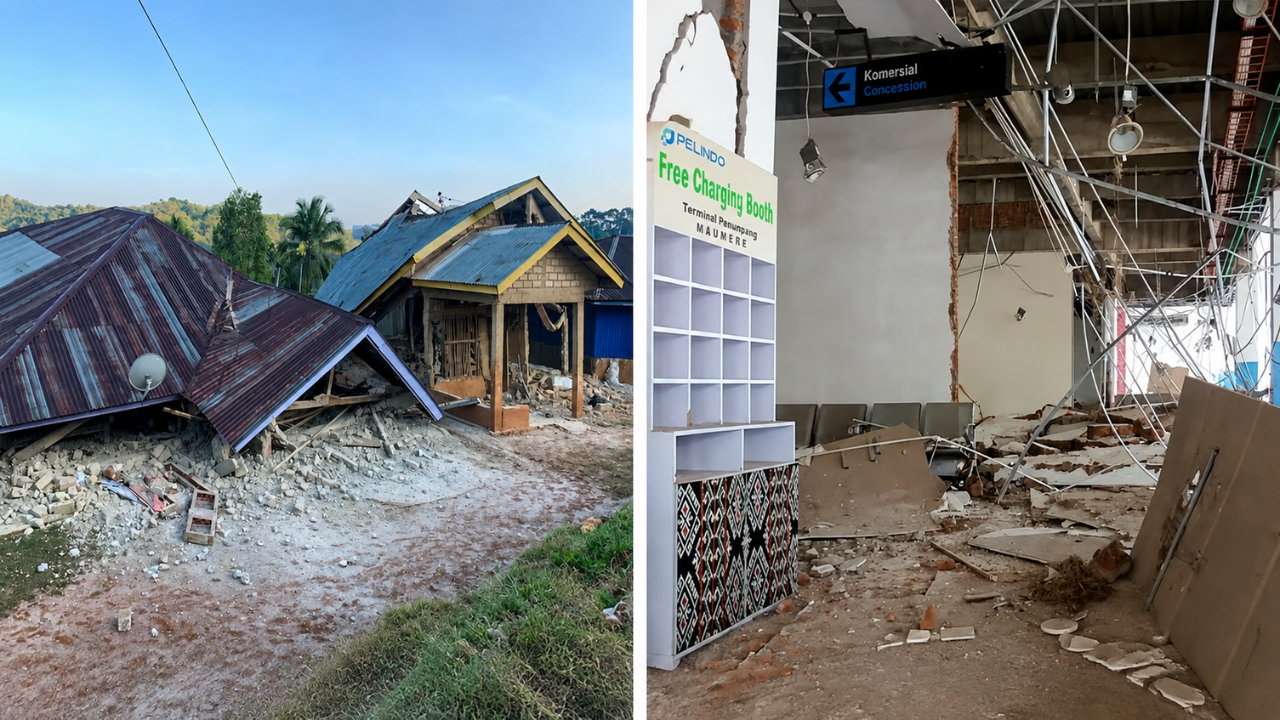
Indonesia Earthquake – An earthquake in Indonesia has killed at least 38 people, raising fears in communities across the region. The 7.7 magnitude quake puts a spotlight on the country’s enduring susceptibility to massive seismic activity, as Indonesia lies on the Pacific Ring of Fire, one of the world’s most seismically active regions. Emergency officials, rescue teams and local communities are assessing the damage, helping residents affected and responding to the aftermath of the disaster.
Major quake strikes Indonesia
The quake was magnitude 7.7 and produced strong shaking in the areas where it struck. Residents said their homes shook violently and buildings and infrastructure were damaged.
The effects of major earthquakes can be felt for a considerable distance from their epicentre in areas with older buildings or little earthquake-resistant infrastructure.
A large earthquake can have a variety of effects, depending on its depth, location, population density and the strength of local buildings.
Death toll rises as rescue operations continue
Authorities were still searching for survivors and assisting victims of the disaster, reports said.
The response to earthquakes is complicated by damaged roads, communication problems and aftershocks that can impede emergency work.
Rescue work is often concentrated on collapsed buildings, medical emergencies and temporary shelter for displaced families.
Why is Indonesia prone to earthquakes?
Indonesia is prone to frequent earthquakes as it sits on the Pacific Ring of Fire, where many of the world’s tectonic plates meet.
The movement of these plates causes strong geological activity such as earthquakes and volcanic eruptions.
Stronger earthquakes can be a huge hazard to populated areas . However , many earthquakes occur offshore or in remote areas .
Affected communities:
Large earthquakes can damage homes, public buildings, roads, bridges and essential services.
Heavy shaking often results in communities without power, water, medical care and transportation.
Emergency agencies typically assess the damage after the first earthquake, before the larger recovery efforts begin.
More Aftershock Problems
After a big earthquake, it can be hours, days or weeks before the aftershocks stop.
Aftershocks can cause damage to already weakened buildings and put people living there and rescue teams in danger.
Officials often advise people to be careful and to avoid buildings that may have structural damage.
Major Earthquake Disasters in Indonesia Before
Over the course of its history, Indonesia has experienced numerous deadly earthquakes.
Due to the geography of the country, disaster preparedness is very important and authorities are investing in monitoring systems, emergency planning and public awareness programmes.
Early warnings, stronger building codes and rapid emergency response have proved useful in the past.
Sources
- United States Geological Survey – USGS Earthquake Data & Seismic Monitoring
Earthquake alert and monitoring – Indonesia Meteorology, Climatology and Geophysical Agency
Reuters – News of disaster coverage worldwide - AP – Disaster news / Global earthquake coverage