

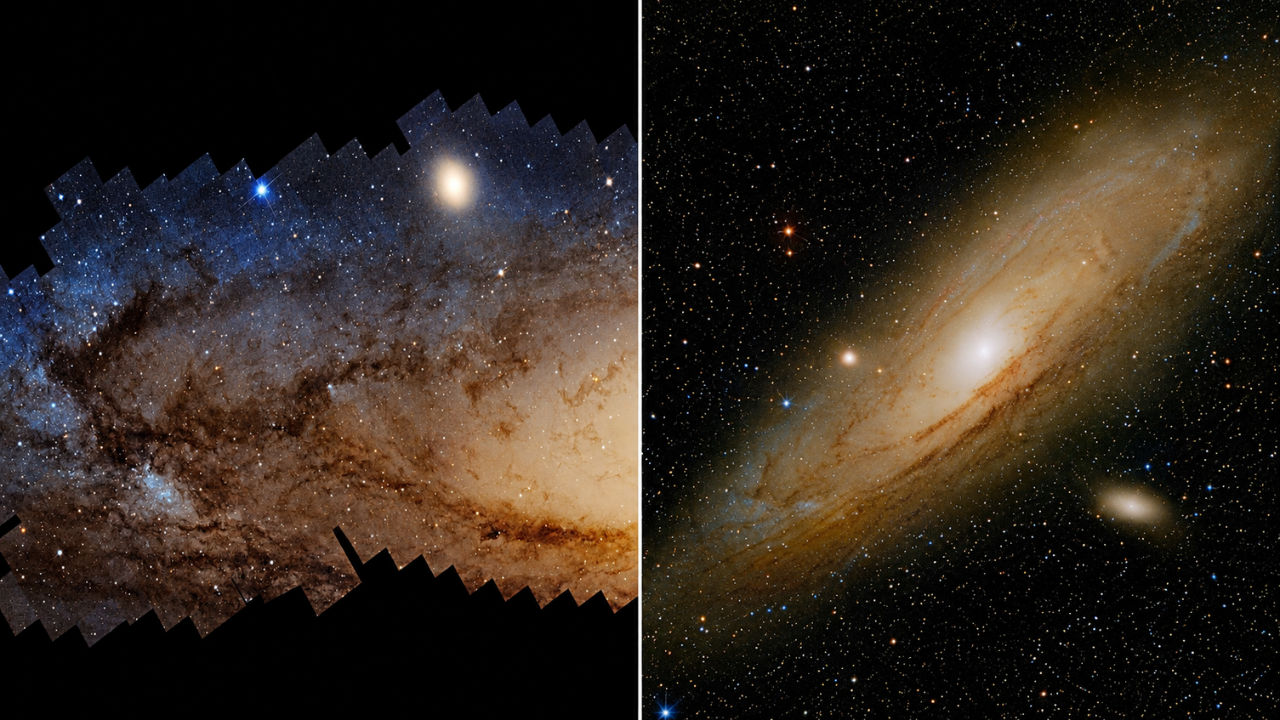
Andromeda Galaxy Star – Scientists have apparently found that star formation is slowing across the Andromeda Galaxy, providing new clues about how large spiral galaxies change as they grow older. The results suggest that Andromeda is producing fewer young stars because it is running out of, or becoming less efficient at creating, dense stellar nurseries from its cold gas reservoir.
The reported slowdown in star formation in the Andromeda Galaxy could help astronomers understand the future of the Milky Way, which shares several similarities with its neighbouring galaxy. But the study’s precise measurements, instruments and conclusions still need official research publications to validate them.
Andromeda is showing signs of change
Andromeda, or Messier 31, is the closest large galaxy to the Milky Way.
It is about 2.5 million light-years away from Earth and contains hundreds of billions of stars and large quantities of gas and dust. Its rate of new star production is lower than it was during earlier stages of its history, but it is still an enormous and active galaxy, the researchers said.
Such a change could be a natural part of galactic ageing.
Cold Gas for New Stars
Stars form in cold and dense clouds of molecular gas.
Gravity slowly pulls material together until the centre becomes hot and dense enough for nuclear fusion to begin. If a galaxy loses gas or cannot compress it effectively, less new star formation occurs.
Andromeda may still contain large quantities of gas but much of it may be too warm, too diffuse or otherwise unsuitable for rapid star formation.
Telescope Data Shows Stellar Patterns
Astronomers watch the clouds and the young, bright stars to learn about how stars are born.
Ultraviolet observations trace young stellar populations, infrared telescopes trace dust and hidden star-forming regions. Future stars can be built from hydrogen and molecular gas that radio instruments can detect.
By piecing together these different observations, researchers can compare active regions with quieter parts of the galaxy.
Andromeda may have been altered by galaxy mergers earlier
It is thought that over its long history Andromeda has interacted with and absorbed smaller galaxies.
These mergers can drive gas inwards and thus temporarily boost star formation. They can also distort a galaxy’s structure, draw material into its centre or hurl gas into regions less conducive to star birth.
There is evidence of disrupted stellar streams around Andromeda consistent with it having experienced several major interactions .
Central Region May Be Less Active
The central region of the galaxy will contain many older stars, and relatively little ongoing star formation.
Radiation, strong winds from stars and activity around the central black hole may heat or strip gas away. This can prevent the gas from cooling sufficiently to collapse into new stars.
Thus star formation may be ongoing in the outer rings and spiral arms of Andromeda.
Discovery Helps Explain How the Galaxy Ages
Galaxies don’t keep forming stars at the same rate forever.
They use up or blow away the gas needed for new generations of stars over billions of years. The bright blue young stars become less common and older stars eventually take over.
This process helps scientists explain why some galaxies appear blue and active and others appear redder and more settled.
Sources
- NASA – Andromeda observations, mission data and galaxy science
- European Space Agency – Space telescope discoveries and science news
- Space Telescope Science Institute – Hubble Imaging and Image Processing.
- The Astrophysical Journal – The leading journal of peer-reviewed research on galaxies and star formation.
- National Radio Astronomy Observatory – Studies of molecular gas and radio astronomy.
- NASA Jet Propulsion Laboratory – News from the infrared and space science missions