

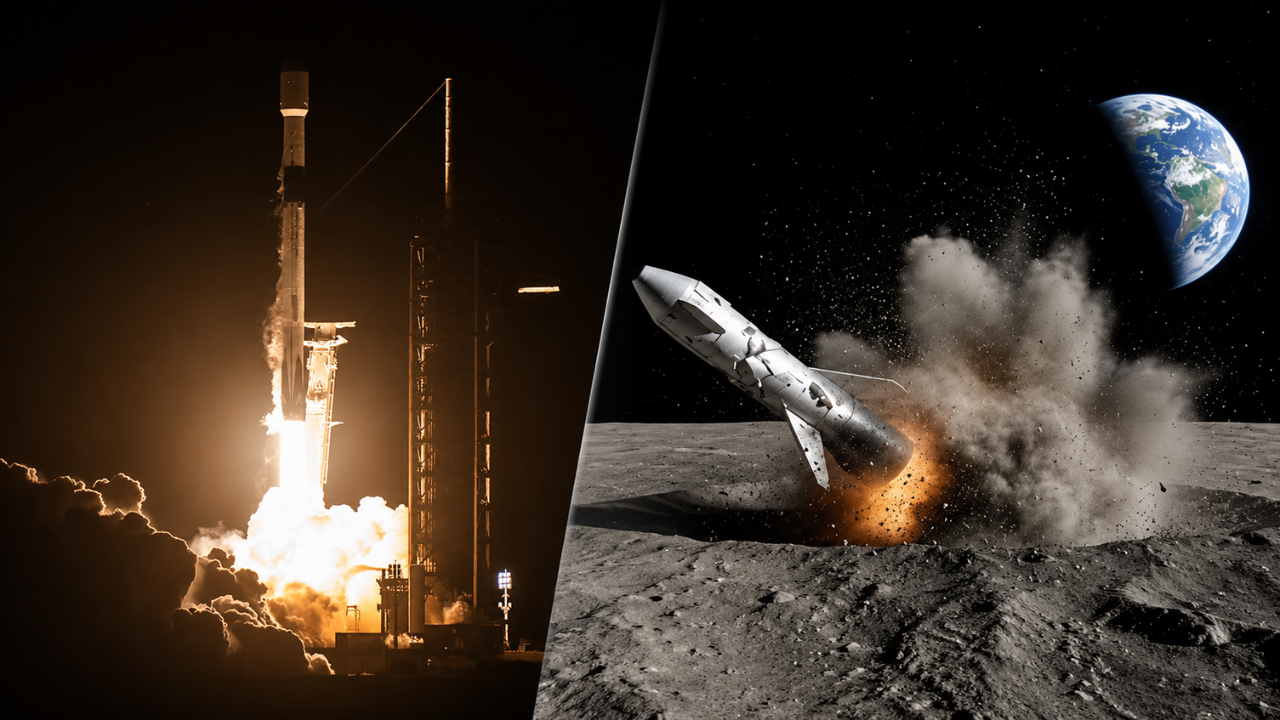
Apparently, a discarded rocket stage slammed into the far side of the Moon at very high speed, creating a new impact site and rekindling interest in tracking abandoned space hardware. The object was initially reported as a SpaceX Rocket Crashes, but further orbital analysis has cast doubt on that identification and suggested the stage may have originated from a Chinese lunar mission.
The reported Moon rocket crash is a reminder of how difficult it can be to spot bits of old spacecraft years after they are launched. Many rocket stages are left in space after their missions are done, and limited tracking data can make it difficult to be sure of their origins.
Early reports gave the edge to SpaceX
The object first caught the eye when independent astronomers calculated it was on a crash course with the Moon.
It was first thought to be the upper stage of a SpaceX Falcon 9 rocket that launched a space-weather satellite in 2015. That made sense, the rocket had passed low Earth orbit and been left on a distant path.
Further analysis later showed the object’s orbit didn’t quite fit the Falcon 9 mission as closely as initially thought.
The Evidence Pointed to a Different Rocket
Later researchers suggested that the stage was more likely linked to China’s Chang’e 5-T1 mission, launched in 2014.
That mission was a test for a future programme to bring back lunar samples. Its upper stage also entered deep space, making it a potential match for the unidentified object.
Chinese officials have disputed the identification, contributing to ongoing uncertainty. Without a permanent tracking record or clear physical evidence it was hard to draw a fully definitive conclusion.
Crash at high speed makes crater
It is reported that the rocket stage crashed on the lunar surface at a few thousand kilometres per hour.
And even an empty stage can send out a lot of energy at that speed. The impact probably formed a crater, ejecting material across the surrounding surface.
NASA subsequently released images showing a strange double-crater formation near where the impact was predicted. Scientists said the shape was interesting because most rocket stage impacts typically leave one crater.
New Questions Raised By Double Crater
The presence of two overlapping craters indicates that the impacting object may have had a considerable mass at both ends.
A lot of rocket bodies are heavily weighted around the engine section with a lighter fuel tank structure leading forward . A balanced object may strike to produce a more complex pattern of impact.
So the unusual crater gave possible clues as to the object’s construction, but did not definitively identify the country or company that built it.
No immediate threat to moon missions
The impact occurred on the far side of the Moon, away from most historic landing sites and active equipment.
It was not a direct threat to the people on earth. Nor were there any astronauts working in the vicinity of the impact site at the time.
But the incident raised future safety concerns as more nations and private firms send spacecraft, landers and rocket stages towards the Moon.
Sources
- NASA – Lunar Reconnaissance Orbiter images and analysis of impact site.
- NASA Goddard Space Flight Centre – Scientific data on lunar craters and spacecraft tracking
- Bill Grey and Project Pluto – Orbital calculations and re-identification of the rocket stage.
- U.S. Space Command – Guidance on space-object tracking data and orbital surveillance.
- European Space Agency – Challenges in space debris research and tracking beyond the earth orbit.
- Reuters – Coverage of contested rocket identification, moon strike Associated Press.