

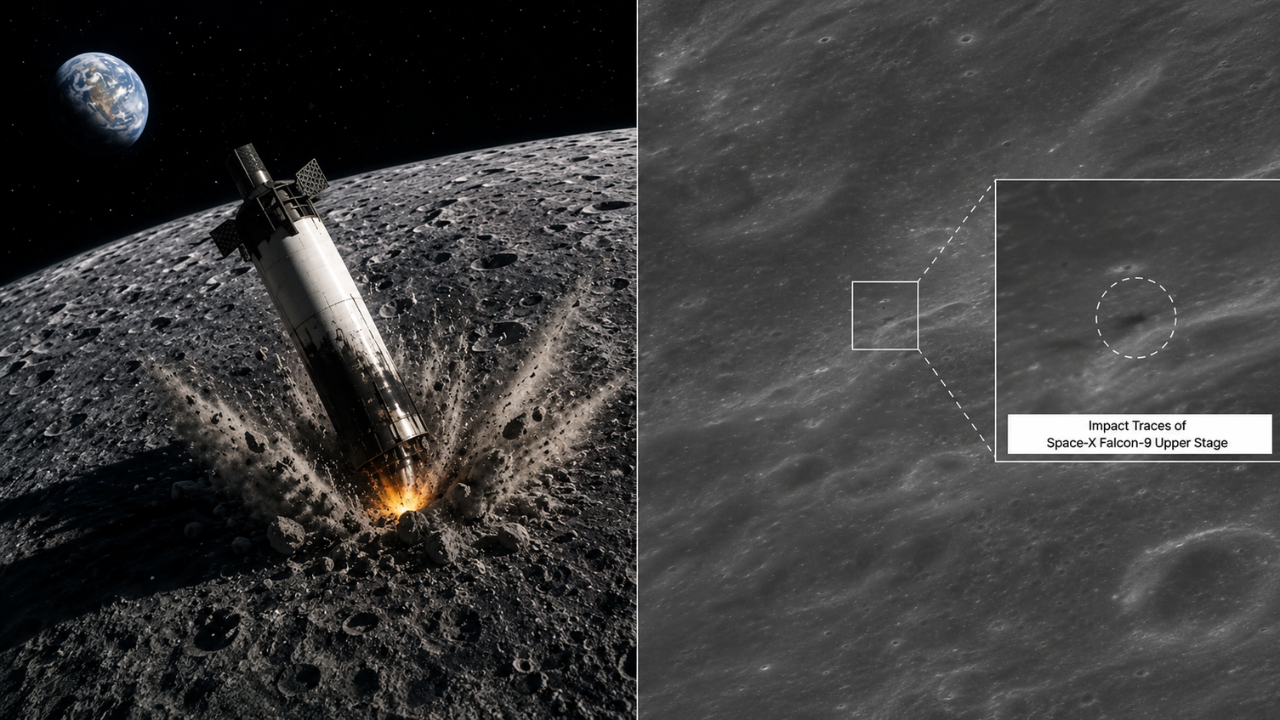
SpaceX Moon Crash – A derelict SpaceX Falcon 9 upper stage has crashed into the Moon after wandering through the cosmos for more than a year. The rocket stage, weighing four tonnes, struck the lunar surface on Aug. 5, 2026, at a speed of some 5,400 mph. Scientists had predicted that the impact would occur near the Einstein crater, but the collision itself was not directly photographed.
The rocket was sent up in January 2025 to deliver lunar spacecraft, and then it was abandoned in an orbit that eventually brought it back towards the moon. Its path was changed by solar activity and gravitational forces.
Scientists Detect Evidence of the Impact
Telescopes did not yield a clear picture of the collision, but scientists saw strong indications that the impact happened as anticipated. Shortly after the expected impact time, the European Southern Observatory’s Very Large Telescope in Chile observed a plume of sodium and lithium.
Researchers believe the material is a combination of the lunar surface material and components related to the rocket. The chemical signatures may offer a unique chance to probe the interaction between artificial objects and the surface of the Moon.
New Crater Could Shed Light on Lunar Impacts
Scientists believe the impact formed a new crater on the moon. Estimates suggest the crater is several tens of metres wide, but its exact size will have to be determined by future observations.
The results could offer useful information about lunar soil, or regolith, and its behaviour when impacted by a large object moving at a high speed. Researchers may also study the resulting debris plume to learn more about how lunar material is distributed after an impact.
Site May Be Explored by NASA, Other Missions
Scientists hope that eventually a lunar spacecraft will be able to photograph the spot of impact and identify the newly formed crater. The observational data from lunar missions like NASA’s Lunar Reconnaissance Orbiter will be useful when the area becomes visible from suitable orbital positions.
If the crater is confirmed, researchers will be able to compare the real impact with computer models made before the collision. These comparisons may allow for improved predictions of future impacts on the moon, and help scientists begin to understand the behaviour of ejecta and dust.
Lunar Activity is Growing, Sparking Debris Worries
The incident is also highlighting the increasing amount of man-made hardware traversing Earth-Moon space. Experts say tracking discarded spacecraft components will become more important as activity around the Moon is expected to ramp up with NASA’s Artemis programme and commercial lunar missions.
The impact by SpaceX was not a planned experiment, but scientists say it is a useful case study of an artificial impact on the Moon in the real world. Researchers are also looking into how future missions can better deorbit upper stages and other hardware after they’ve completed their primary objective.
Sources
- Associated Press – Scientists confirm SpaceX rocket stage hit the Moon, describe debris plume detected.
- The Guardian – Analysis of lunar impact and predicted crater formation, and the detection of sodium and lithium signatures.
- European Southern Observatory – Scientific observations and telescope data of the impact on the Moon.
- Scientific American – History of the Falcon 9 upper stage , estimated collision and consequences for lunar space debris .