
Nike is set to leave the S&P 100 on September 21, 2026, ending nearly 18 years of membership in the index of major U.S. companies. S&P Dow Jones Indices announced the change as part of its latest quarterly index rebalance.
The removal does not mean Nike is leaving the stock market or the broader S&P 500. Nike shares will continue trading under the ticker NKE, and the company will remain in the S&P 500. The change instead affects its membership in the narrower S&P 100, which tracks 100 major U.S. companies.
What Happened?
S&P Dow Jones Indices announced on September 4 that Nike will be deleted from the S&P 100 before the market opens on Monday, September 21, 2026.
Nike is one of four companies leaving the index in the quarterly rebalance. The other departures are Honeywell Aerospace, Simon Property Group and Colgate-Palmolive.
Dell Technologies, Palo Alto Networks, Arista Networks and SanDisk will replace them. The changes are designed to make the respective indices more representative of their market-capitalization ranges, according to S&P Dow Jones Indices.
The decision comes after a prolonged period of pressure on Nike’s stock and business performance. Recent market reporting has highlighted the company’s significant decline from its previous stock-market highs, while Nike’s own financial results show that revenue growth has remained challenging in several important markets.
Key Details
Here are the confirmed details of the S&P 100 change:
- Company: NIKE, Inc.
- Ticker: NKE
- Index: S&P 100
- Action: Deletion
- Effective date: September 21, 2026
- Index reason: Quarterly rebalance and changes intended to keep the index representative of its market-capitalization range
- S&P 100 status: Nike will leave the S&P 100
- S&P 500 status: Nike remains in the S&P 500
Replacement: Nike’s S&P 100 position is part of a broader reshuffle that adds Dell Technologies, Palo Alto Networks, Arista Networks, and SanDisk.
The distinction between the S&P 100 and S&P 500 is important. The S&P 100 is a subset made up of 100 major U.S. companies, while the broader S&P 500 contains approximately 500 leading companies.
Therefore, Nike’s removal from the S&P 100 should not be interpreted as an exclusion from the major U.S. equity market benchmarks altogether.
Why It Matters
The S&P 100 position is an important marker of Nike’s standing among the largest and most prominent publicly traded U.S. companies.
Nike’s departure also comes during a broader effort by the company to rebuild growth and improve its product portfolio. Its fiscal 2026 results show a business that remains enormous but is dealing with uneven demand across regions and sales channels.
Nike reported $46.4 billion in fiscal 2026 revenue, essentially flat from the previous year on a reported basis and down 2% on a currency-neutral basis. Net income was $3.1 billion, down 3%.
The regional picture was mixed. Nike brand revenue declined in Greater China and Europe, the Middle East and Africa, while North America provided growth. Nike said fiscal 2026 Greater China revenue fell 13% on a currency-neutral basis.
Nike Direct was another weak area. Full-year NIKE Direct revenue fell 6% on a reported basis and 8% on a currency-neutral basis, with NIKE brand Digital revenue declining 12%.
Those figures help explain why investors have been closely watching Nike’s turnaround efforts. However, the S&P 100 change itself should not be described as a direct punishment for any single earnings result. S&P Dow Jones Indices said the quarterly changes are intended to maintain the index’s representation of its market-capitalization range.
Nike’s Stock Decline Adds Context
Nike’s stock performance provides important context for the company’s changing market position.
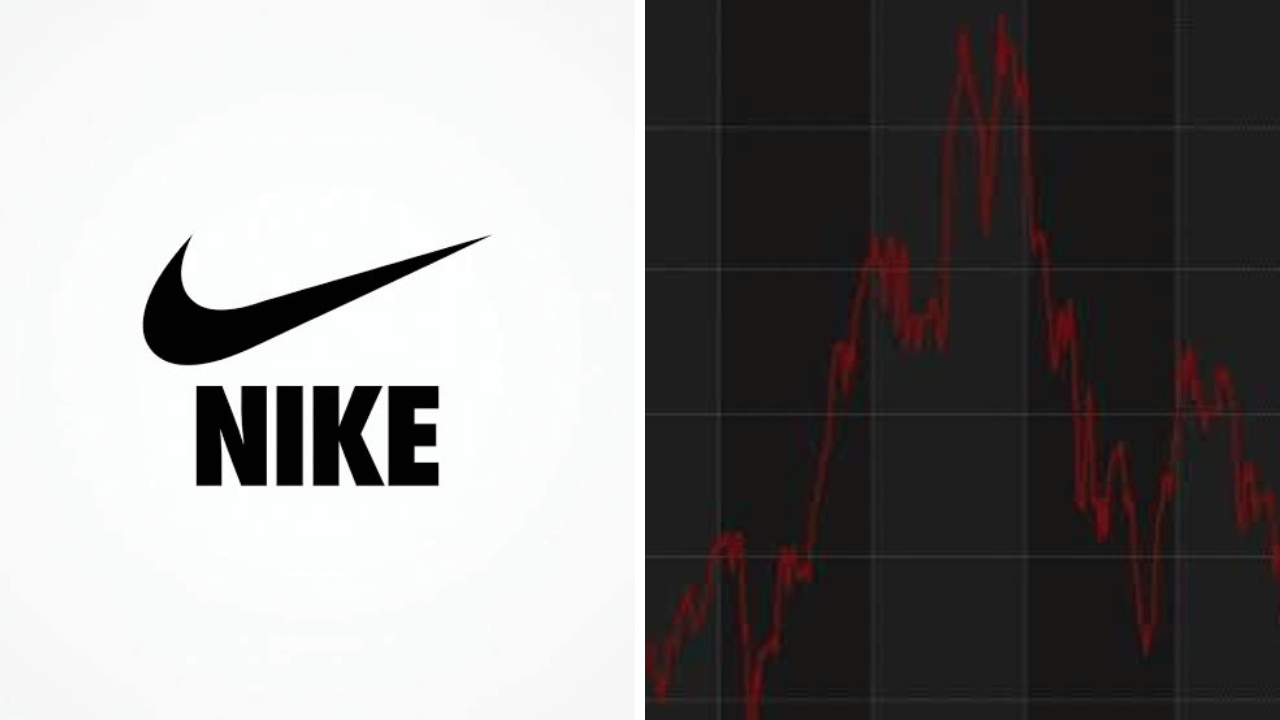
Recent market reports put NKE shares around the high-$30 range in early September, substantially below the company’s previous peak. MarketWatch reported that Nike shares closed at $38.12 on September 1 and were about 50% below their 52-week high at that point.
Other recent reports have highlighted a much larger decline from Nike’s 2021-era peak. Because the exact percentage varies depending on the comparison date and whether intraday or closing prices are used, it is safer to describe the move as a substantial long-term decline rather than rely on a single percentage.
The important point is that Nike’s market value has fallen significantly while other companies have grown enough to qualify for inclusion in the S&P 100.
Background
Nike has been working through a multi-year reset under CEO Elliott Hill, who returned to the company in 2024 after previously holding senior positions at Nike.
The company’s latest financial results show both progress and continuing challenges.
For fiscal 2026, Nike’s wholesale revenue increased 6% on a reported basis, while NIKE Direct revenue declined 6%. Gross margin for the full year increased slightly to 42.9%.
Nike has also continued returning capital to shareholders. The company said it returned approximately $2.5 billion to shareholders during fiscal 2026 through dividends and share repurchases.
At the same time, the company has been trying to improve its product portfolio, strengthen its marketplace position, and manage expenses. Nike’s management has described these actions as part of its effort to improve the health of the business and return to profitable growth.
The S&P 100 change therefore arrives at a meaningful point in Nike’s turnaround, although the index decision itself is based on S&P’s index methodology and rebalance process.
What Happens Next?
The S&P 100 changes will take effect before trading begins on September 21, 2026. Nike will remain publicly traded and will continue to be included in the S&P 500.
For investors, the more important long-term issue is whether Nike can rebuild sales momentum and improve its competitive position.
The company is scheduled to report its fiscal 2027 first-quarter results on October 1, 2026, according to Nike’s investor-relations calendar. That earnings report will provide a fresh look at the company’s progress after the S&P 100 change takes effect.
Nike’s next results will be particularly relevant for investors watching North American demand, Greater China, NIKE Direct, margins, and the company’s broader turnaround strategy.
Frequently Asked Questions
- Why is Nike being removed from the S&P 100?
S&P Dow Jones Indices announced Nike’s deletion as part of its quarterly rebalance. The index provider said the changes are intended to keep its indices representative of their respective market-capitalization ranges.
- When will Nike leave the S&P 100?
Nike’s removal will become effective before the U.S. market opens on September 21, 2026.
- Is Nike leaving the S&P 500?
No. Nike is being removed from the S&P 100, but it will remain a constituent of the S&P 500.
- Is Nike’s stock still publicly traded?
Yes. Nike will continue trading on the New York Stock Exchange under the ticker NKE. Its removal from the S&P 100 does not end its public listing.
- What is happening to Nike’s business?
Nike reported $46.4 billion in fiscal 2026 revenue, which was flat year over year on a reported basis and down 2% on a currency-neutral basis. The company also reported declines in Greater China and NIKE Direct, although wholesale revenue increased.
Conclusion
Nike’s upcoming removal from the S&P 100 marks a notable change for one of America’s best-known consumer companies after nearly 18 years in the index.
The move is part of S&P Dow Jones Indices’ quarterly rebalance rather than a standalone judgment on Nike. Still, it arrives against the backdrop of a significant stock decline, uneven regional sales and an ongoing effort by Nike to rebuild growth.
The company will remain in the S&P 500 and continue trading as NKE. The next major test for investors will be whether Nike’s turnaround can produce stronger operating performance in the quarters ahead.