

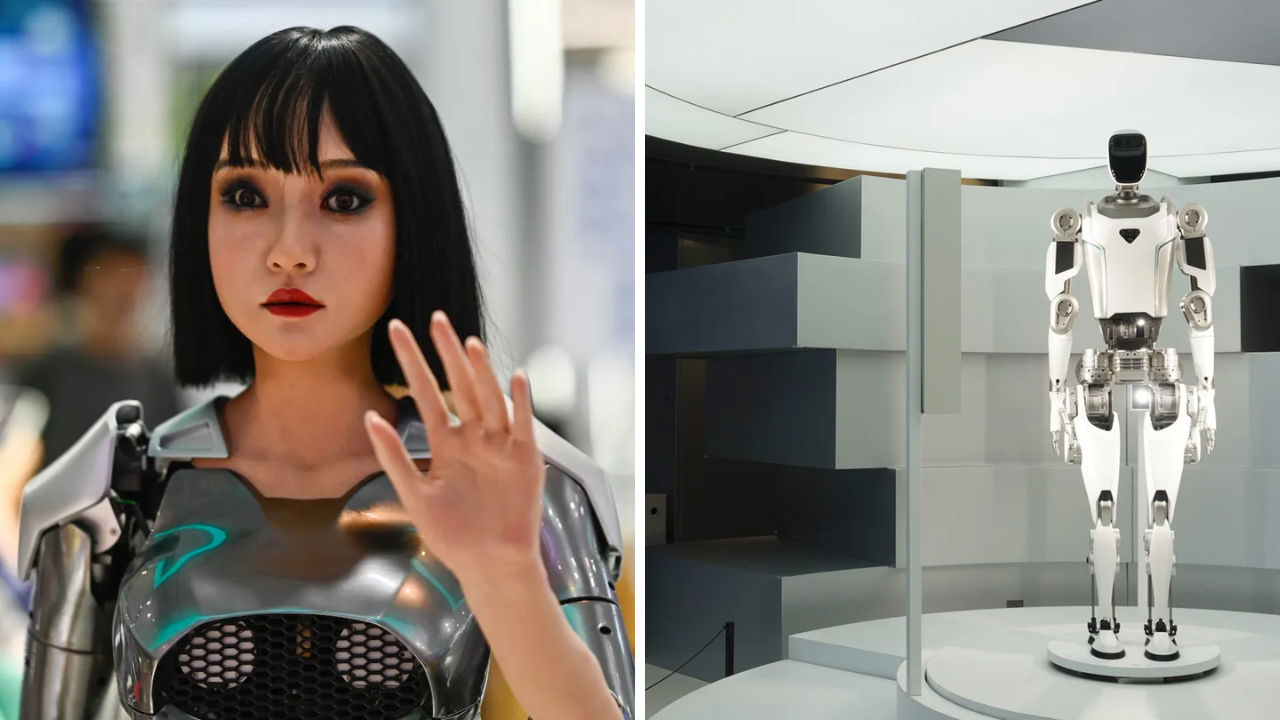
Humanoid Robot – The competition to build sophisticated human-like robots is intensifying around the world as U.S. and Chinese companies and research institutions invest heavily in AI, robotics and automation. Rapid advances in artificial intelligence models, computer vision and robotic hardware are fueling a race between two of the world’s largest technology markets to develop human-like machines capable of performing a wider range of complex tasks.
But experts say the competition is about more than just robotics itself, even as both countries are making huge strides. The speed at which humanoid robots will enter daily industries and the future of humanoid robots will depend on advancements in AI chips, software, manufacturing and supply chains.
AI Speeds Up Development of Humanoid Robots
Latest humanoid robots are AI based, Today, AI means robots can identify objects, understand spoken commands, adjust to shifting environments and make decisions on the fly.
Robots were only able to do what they were programmed to do. AI-enabled machines are now much better at adapting to new situations. This flexibility makes human-like robots more and more useful in manufacturing, logistics, health care, research and customer service.
The advances in large language models and machine learning will also make these robots more capable.
U.S. Companies Encourage Innovation Still
Several U.S. tech companies are investing heavily in humanoid robotics to increase productivity and automation at work. There are many projects aiming to build robots capable of performing repetitive or physically demanding jobs and working safely with human colleagues.
Developers are also discussing applications in warehouses, factories, retail settings and health care facilities. Better sensors, more powerful AI processors and improved battery technology are making these machines more useful.
The U.S. has strong research institutions, AI development and private investment that continues to stimulate creativity throughout the robotics industry;
China increases robotics investment
China has also put humanoid robotics on the strategic agenda and is investing heavily in artificial intelligence and advanced manufacturing . Companies across the country are beginning to deploy new robotic platforms for industrial production, logistics and service applications.
Chinese companies have a strong manufacturing base that could enable them to increase output more quickly and perhaps cut costs as demand rebounds. Government-supported robotics research has also yielded new technologies that make robots more mobile, more precise and more intelligent.
By these criteria China has become one of the top competitors in the domain of robotics.
More Than Hardware Competition
The United States and China are racing to make more than better robotic bodies. More and more, success depends on AI software, semiconductors, cloud computing, battery efficiency and data processing.
Businesses that can pair powerful AI models with trustworthy hardware are likely to be rewarded with commercial deployments. But as humanoid robots become more sophisticated, safety systems, cybersecurity and regulatory compliance will also be key.
That larger technology ecosystem probably will play a role in how fast it takes for robots to move from demos to real workplaces.
Industries could be upended
As they gain more capability, businesses may start using humanoid robots for more jobs. Manufacturing is still one of the most likely first markets. But logistics, hospitality, elder care, health care support and construction are also being considered.
Most experts agree that robots will work alongside humans, rather than completely replacing them. Robots will do the dull or dangerous jobs, but human workers will still be needed for jobs that require creativity, judgement and complex interpersonal communication.
Cost, reliability, regulation and public acceptance will dictate how quickly it is adopted.
There will likely be continued global competition
Humanoid robotics will be one of the most competitive fields of artificial intelligence in the coming years, as the United States and China are pouring more and more money into this field. “More progress in AI, computing power and robotics engineering is likely to produce more and more capable machines in many industries.
It’s unknown what the long-term result of the competition will be, but the fast pace of innovation suggests that humanoid robots could play a much larger role in the global economy than they ever have before.
Sources
- NVIDIA – talks about the latest advances in AI computing, robotics platforms and technologies behind the development of humanoid robots.
- Boston Dynamics – Boston Dynamics publishes definitive information on state-of-the-art robotics research and real-world robotic applications.
- Tesla AI – Tesla on its AI and automation technologies and humanoid robotics programme
- Reuters – Technology competition, AI development, investment in robotics and international business news from Reuters.
- IEEE Spectrum – IEEE Spectrum covers engineering, science and technology news, including engineering breakthroughs, research and discovery.